Why PR for small businesses matters more in 2026
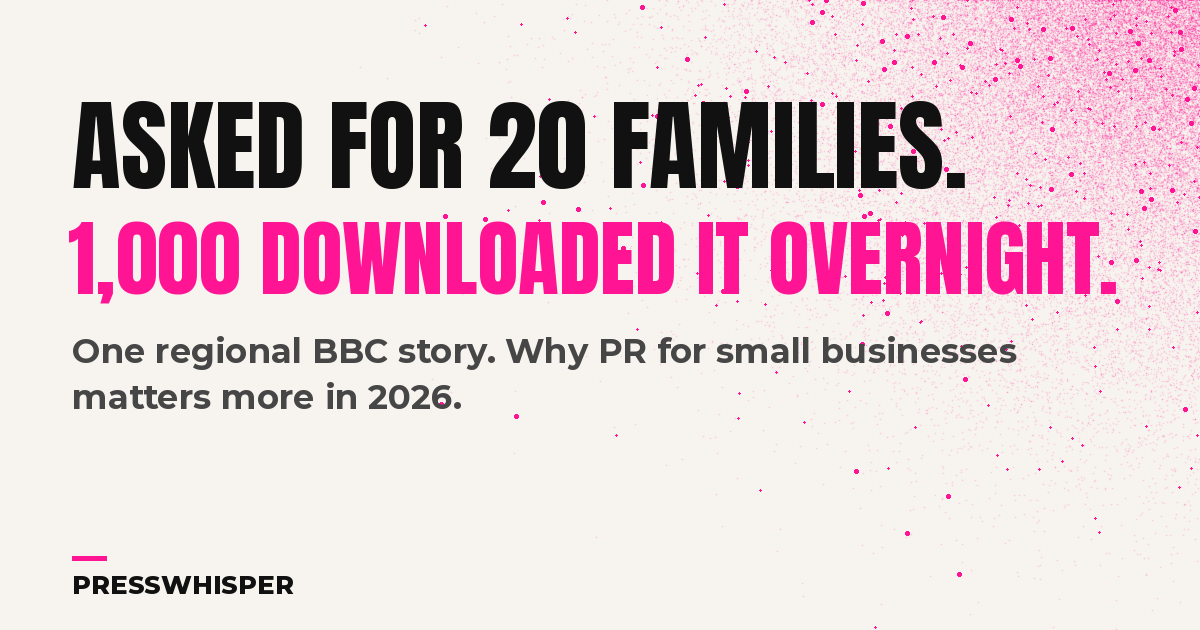
In 2025 Ben Cosh asked for 20 families in Bristol to test an early version of his app for parents of autistic and ADHD children. In May, BBC News ran a regional story about it. By the next morning it had 1,000 downloads.
The app is called Sylva now, and it's had almost 10,000 downloads.
If you run a small business, a startup or a mid-size company and you want more customers, you need press coverage. Your customers are sold to from every direction, so they've learned to tune it out. And when they ask an AI tool what to buy, it almost never cites anything that was paid for.
Why is PR important for small businesses?
People buy from businesses they trust, and they've stopped taking your word for it.
Edelman's 2026 brand study asked 17,688 people in 15 countries, the UK included, why they buy. Of those, 88% said trusting the brand was an important reason. That puts trust level with value and quality.
Meanwhile, everybody's selling at them. Consumers get ads in every feed, and now a flood of AI-made content on top. In a Gartner survey published in September, 65% of US consumers said brands produce too much of it, and 57% said it has made them trust brand messaging less.
Business buyers are drowning too. In one week this October, six strangers emailed our team inbox. Five wanted to put PressWhisper on a list. One wanted to know what was standing in our way. Emails like that, mostly. The average office worker gets 117 emails a day (Microsoft), and 73% of B2B buyers actively avoid suppliers who send them irrelevant outreach (Gartner).
They go looking for someone who isn't you. Only 20% of the people in Edelman's study said a brand's own ads and website do most to decide whether they trust it. Twice as many, 41%, said it's what people the brand doesn't pay say about it, like friends and reviews. Journalists and analysts got their own box on top of that. Press coverage is the one on that list you can go out and get.
What's the difference between PR and advertising?
You pay for advertising, so you control every word, and your customers know it. A journalist can't be paid to write about you, which is why it counts when they do. In marketing speak, that's paid media versus earned media.
Nobody's claiming journalists are saints. Ipsos found 26% of Britons trust them to tell the truth. Advertising executives managed 16%.
PR works whether you sell to businesses or to the public. vvast sells compliance reporting software to ecommerce brands. Not an obvious front page, but it was Business News South West's top story 48 hours after the press kit went out (how vvast did it). Fausto is a print magazine for cyclists. It had six yeses from the press in ten hours, and PRINT, the design magazine, wrote it up. We wrote both sets of pitches, and I'll be bringing that up for years.
Why does earned media matter for AI search?
AI tools build their answers from what other people say about you. Muck Rack's May 2026 study looked at more than 25 million links cited by ChatGPT, Claude and Gemini. Paid content was 0.3% of them. Journalism was 27%, and more than half of that journalism was under a year old. McKinsey found a brand's own websites are often only 5 to 10% of the sources AI search cites.
Your buyers are already asking these tools. Half of US consumers use AI search, says McKinsey, and 94% of business buyers now use generative AI somewhere in their buying (Forrester, January 2026). When they ask which supplier or app to go for, the AI leans on the ones that have been written about.
PR and SEO now feed each other. A news story gives the AI tools a mention to cite, and when it links to you, Google counts that too. My earlier post, Why PR for startups now needs a free press kit, covers the SEO side. It also shows how ChatGPT and Google's AI Overviews pick their sources.
What does PR do for startups and small businesses?
PR gets strangers to trust you before they've bought anything. Which strangers depends on what you're building.
If you're a startup, you've got no track record, no reviews and a website you wrote yourself at 1am. PR for startups is how you borrow a journalist's credibility until you've built your own. Coverage is what investors and early customers find when they search your name, and they will search your name.
PR for small businesses and SMEs usually starts closer to home. Sylva's BBC story and vvast's were both regional. Most small businesses sell to people nearby or people in their trade, and those people read regional papers and trade titles. Start there.
Once you've got coverage, use it. Put the logo on your homepage and the link in your sales emails.
Do mid-size companies still need PR?
They do, but the job changes. Once people in your sector know your name, you're past proving you exist. Now you want to be the name that comes up first. That means the trade press, and the answer a buyer gets when they ask ChatGPT who's best at what you do.
That's most of B2B PR now. 6sense surveyed about 4,000 B2B buyers in 2025. On average they were 61% of the way through before they first contacted a seller. The company that won was on their day-one shortlist 95% of the time. Buyers mostly shortlist names they already know. Coverage is one of the ways a stranger becomes one of those names. If your competitors have the coverage and you havent, nobody's going to guess in your favour.
Can a small business do its own PR?
Yes. An agency sells you a story and a list of journalists who might care about it. You can find both yourself, and it's mostly graft. Work out what about you is news to someone else's readers. Then find the reporters who've covered your patch lately and email them one at a time.
I nearly learned that the expensive way. The agencies I asked quoted up to £5,000 a month, six months minimum, to get a jacket brand into a magazine. Whito's 2026 benchmarks put UK retainers at £2,000 to £3,500 a month at entry level, and £3,000 to £8,000 for a standard one. I went home in a mood and built PressWhisper instead.
A PressWhisper press kit is free to build, and we don't ask for a card. Give it about 20 minutes. You can send it to journalists from your own inbox for nothing. That's the cheapest way I know to get media coverage for your business.
If you'd rather not hunt for journalists yourself, our Self Serve plan finds up to 20 who are most likely to cover your story. You send the pitches from one dashboard, and it's £120 a month. Or White Glove does the lot for one fee, no retainer.
What if no journalist writes about you?
You've still got a press kit online at your own presswhisper.com address. The text is written into the page rather than loaded in afterwards. Google and the AI crawlers from OpenAI, Anthropic and Perplexity can all read it. It's tagged as a news article for search engines, and the link back to your website is one Google counts.
That's one more page about you that can rank for your name. When someone asked Perplexity for wild venison delivery inside the M25, it put Noble & Wild top and listed their PressWhisper kit among its sources.
Worst case, you get a free page about your business with a backlink to your site, on a website the AI tools already cite. At that price, trying it is a no-brainer.
FAQ
Is PR worth it for a small business?
It is, if you've got a story a journalist's readers would care about. Coverage keeps working after the day it runs: customers find it when they look you up, and so do Google and the AI tools. Starting costs nothing. A PressWhisper press kit is free, and you can pitch from your own inbox.
What are the benefits of PR for a business?
Trust, mostly, and trust turns into money. The Earned Effect study by Weber Shandwick and the IPA (2023) looked at more than 340 campaigns from the IPA's effectiveness databank. The ones that earned coverage and conversation over the long term were 2.6 times more likely to deliver very large profit growth. Online coverage often links to your website too, which Google counts, and AI tools cite it.
What is earned media?
Earned media is coverage you don't pay for: articles, reviews, interviews and mentions that happen because someone decided you were worth writing about. Paid media is advertising. Owned media is your own website and social posts. Earned media dominates AI answers. Muck Rack found 84% of the links cited by ChatGPT, Claude and Gemini came from sources the brand neither owned nor paid for. Paid content was 0.3%.
How do I get my business in the newspaper?
To get your business in the newspaper, start with your local paper and the trade titles your customers read. Work out what in your story is news to their readers. It's rarely your launch. Put the facts, images and contact details in a press kit. Then email a short pitch to the reporter who covers your area, with a link to the kit.
How long does PR take to work?
Days, once the pitches go out. The first yeses can come within hours: Fausto had six in ten hours. vvast was Business News South West's top story 48 hours after its kit went out.
Does press coverage increase sales?
The right coverage sells, and fast. When BBC One's Inside the Factory featured Dualit in January 2025, sales of its Classic Toaster that week were up 189% on a year earlier (ERT). Sylva asked for 20 testers and got 1,000 downloads overnight from one regional BBC story. Get your website ready for the traffic before the piece runs.
What is PressWhisper?
PressWhisper is a PR platform for small businesses and startups, built in Cornwall. Building a press kit is free. Self Serve, at £120 a month, matches your story to up to 20 journalists most likely to cover it. You pitch them from one dashboard. White Glove is the done-for-you version.
About the author
Jim Edmondson co-founded PressWhisper after PR agencies quoted him around £5,000 a month, six months minimum, to pitch AVRE Industries, the heritage clothing brand he started with historian James Holland and comedian Al Murray. He took it personally and built the software instead. PressWhisper clients have since been covered in PRINT magazine and on TheBusinessDesk. He's dyslexic and lives in Cornwall. presswhisper.com