Why PR for startups now needs a free press kit
On 17 October we typed "how to get press coverage for my startup" into Google. Twice. Both times the top of the page was Google's AI Overview, an answer written by Gemini. Building a press kit was one of the first jobs it gave founders. One run said to keep it all "in one easy-to-access link".
Nearly every line had a tiny logo next to it. The AI was showing its working: HSBC Innovation Banking, Speedinvest, Startups.com, Babson College, Forbes, Medium, LinkedIn, YouTube and a Reddit thread from r/startups.
Sites like those are where PR for startups now has to land. A free press kit is the quickest way I know to start getting onto them.
Most people stop at Google's AI Overviews
Google says its AI Overviews hit 2.5 billion monthly users this year. ChatGPT passed a billion weekly users in August.
And we don't click. Pew Research tracked the searches of 900 US adults. When an AI summary appeared, they clicked a normal result on 8% of visits. With no summary it was 15%. The links inside the summary got clicked on 1% of visits.
You've probably done it today. Ask, read the paragraph, put the kettle on.
That paragraph is your shop window now. To get into it, you need to be on the sites behind those little logos (favicons, if you want the proper word).
How do ChatGPT and Google's AI Overviews choose their sources?
Google's AI Overviews and AI Mode draw on Google's own search index. The firms behind ChatGPT, Claude and Perplexity send crawlers round the web to read public pages.
A PDF press kit attached to an email reaches one journalist if you're lucky, and no crawler. Put it in a Google Drive folder that asks for permission and nobody reads it. Plenty of modern websites need JavaScript before they show a single word, too. When Vercel tested the big AI crawlers in late 2024, Google's ran JavaScript. OpenAI's, Anthropic's and Perplexity's didn't, so on those sites they saw a blank page.
We learned this one the embarassing way. A few weeks ago our own site was showing AI crawlers a title, a few meta tags and nothing else. It's fixed now. To check yours, open your homepage in Chrome on a laptop, right-click and choose View page source. If you can't find your own words in there, those crawlers can't see them either.
Which websites does AI search trust?
Mostly the ones you can't pay to be on.
Muck Rack's May 2026 report looked at more than 25 million links cited by ChatGPT, Claude and Gemini. Of those, 84% were earned media, meaning coverage and mentions nobody paid for. Paid and advertorial content was 0.3%. Journalism on its own was 27% of everything cited, and more than half of those articles were under a year old.
Ahrefs came at it from the other side in 2025. It looked at 75,000 brands and measured which signals lined up with a brand appearing in Google's AI Overviews. Brand mentions around the web scored 0.664, where 1 is a perfect match. Backlinks scored 0.218.
As a founder you want your name, and a link back to you, on as many of the sites AI search trusts as you can get. Press coverage has done that for years. Agencies now sell a version of it as generative engine optimisation, or GEO.
What does a free press kit on PressWhisper do?
Your kit goes live at your own PressWhisper address, something like presswhisper.com/press/your-company/your-story. A built-in guide walks you through it and a critique scores what you've written. It takes about 20 minutes and costs nothing. No card.
It holds your story, the key facts, your founders, talking points, images and how to reach you. Journalists need all of that to write about you, and so does an AI, which guesses when something's missing.
The words are in the page itself, so crawlers that skip JavaScript still read them, and we don't block any. The page is marked up as a news article, so search engines know what they're looking at. It also links back to your website with a normal link they can follow. Link to the kit from your own site as well, from a press page or the footer. Crawlers find pages by following links.
Then you send it to journalists, from your own inbox or through our Self Serve plan. If one writes about you, you're on the kind of site AI search cites.
Business News South West made Bristol compliance software firm vvast its top story 48 hours after the kit went out. Fausto, a print cycling magazine, got six yeses in ten hours and a write-up in PRINT, the design magazine. We wrote the pitches for both.
Do AI answers actually cite press kits?
They already cite ours.
Someone asked Perplexity for "wild venison delivery inside the m25". Top of the table came Noble & Wild, a brother-and-sister wild venison business in the Highlands: M25 only, £100 a box, £90 on subscription. All of that is in the press kit they built on PressWhisper. Hover over the logos above the answer and there's our pink PW, with the kit's headline in the list of pages it read.
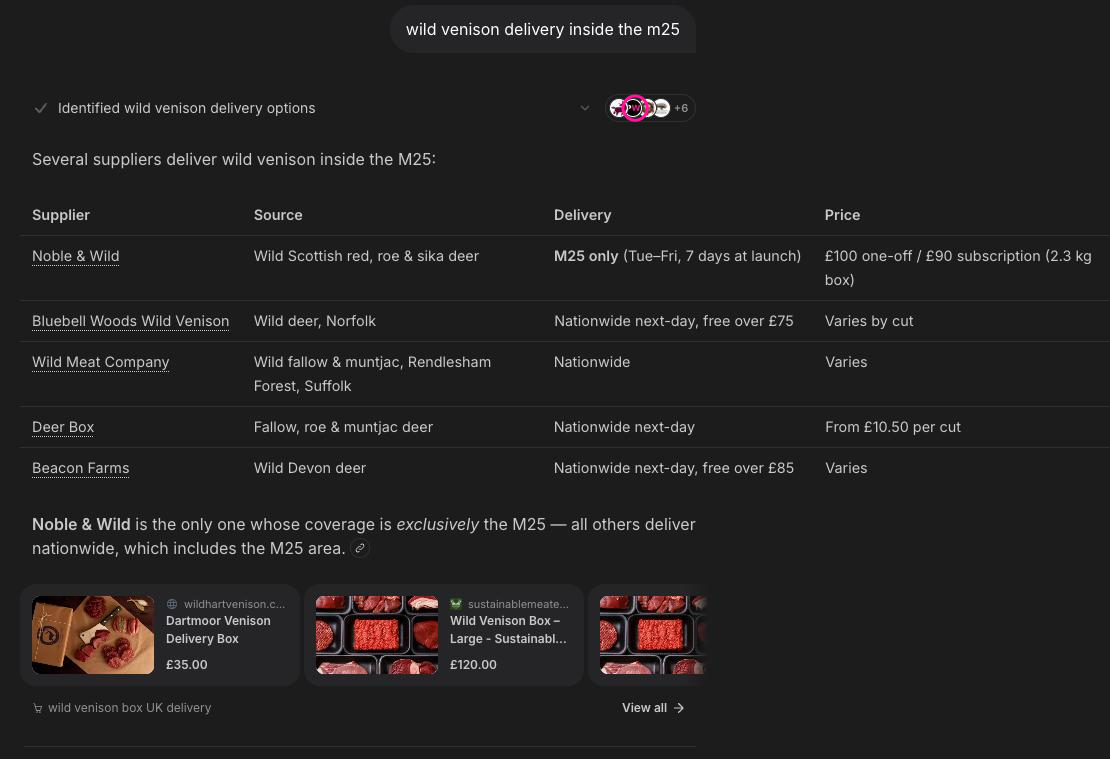
Perplexity, asked for wild venison delivery inside the M25. Our favicon is circled.
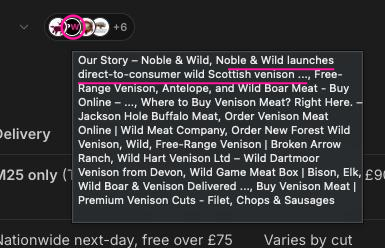
Hover over the logos and Noble & Wild's kit is in the list.
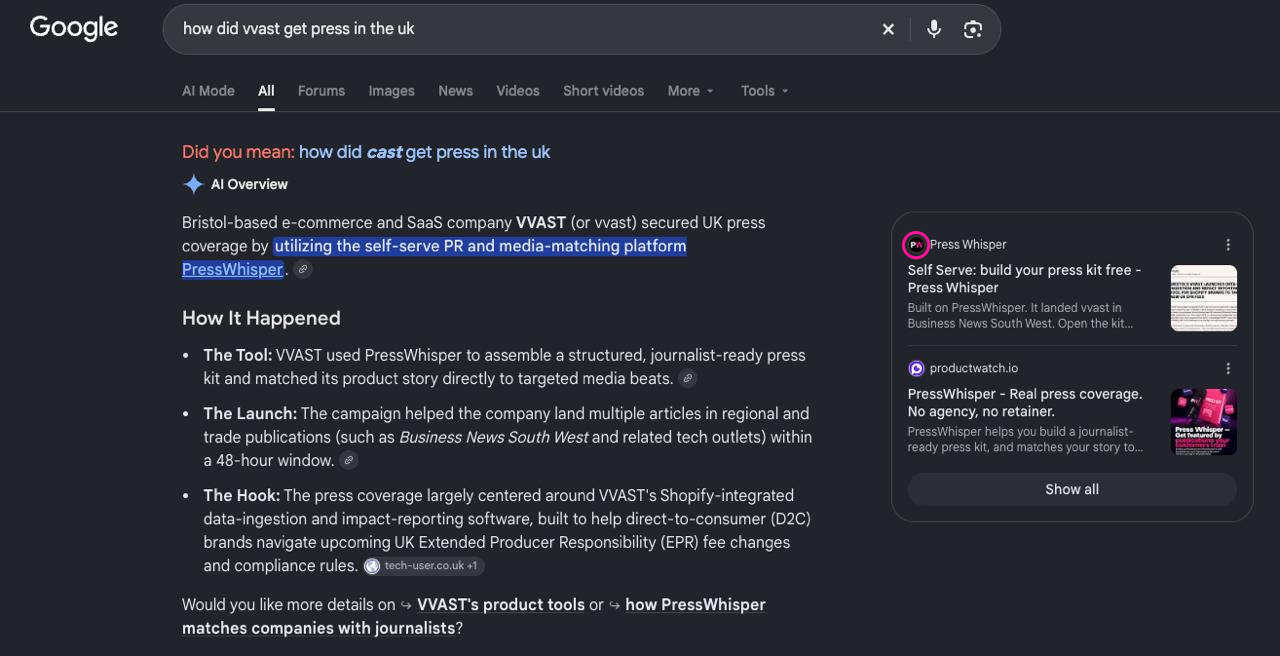
Google does it too. Ask it "how did vvast get press in the uk" and the AI Overview names PressWhisper in its first sentence. The first source in the panel beside it is one of our pages. That's the screenshot at the top of this post.
No one paid for either answer.
Try the favicon test on your own market
Type the question your customer would ask into Google. "Best [what you sell] in [your town]." "How do I [the problem you fix]." Then ask ChatGPT the same thing.
Write down every logo under the answers. That's your press target list, the outlets and forums the AI already trusts in your corner of the world. Pitch the news sites on it. Post on LinkedIn and the forums yourself.
Is a free press kit really a no-brainer?
I got quoted £5,000 a month to get a jacket brand into a magazine. Six months minimum. Whito's 2026 benchmarks on PR for small businesses put entry-level UK retainers at £2,000 to £3,500 a month. A typical small business pays £3,000 to £8,000.
The kit is free, and so is sending it from your own inbox.
Once it's up, post it on LinkedIn, which turned up twice as a source in that Google answer. Update it whenever something changes, because AI search leans hard on recent pages.
FAQ
What is a press kit?
A press kit is one place with everything a journalist needs to write about your company: the story, key facts, founder bios, quotes, images and contact details. Online, people call it a digital press kit, an online press kit or an EPK. Some say media kit, though that name also gets used for advertising rate cards.
What should a startup press kit include?
Why the company exists, key facts and numbers, founder bios, two or three talking points, plus high-resolution images and logos. Add any coverage you've already had and a named contact with an email address. Keep it on one web page a journalist, or a crawler, can read without logging in. Here's a real press kit example from vvast.
Is a PressWhisper press kit really free?
Yes. Building your kit and hosting it at your own PressWhisper address is free, and you don't need a card. Matching your story to journalists and sending the pitches is on the paid Self Serve plan.
How do I get press coverage for my startup or small business?
Find the story a journalist's readers would care about, which is rarely your launch. Put it in a press kit with the facts and images ready. Then pitch a short list of journalists who already cover your area, with a short email and the kit link. PressWhisper caps each story at 20 journalists for that reason.
Why doesn't ChatGPT mention my company?
Usually because nothing it trusts mentions you, or because it can't read the pages that do. Check your words appear in your homepage's page source. To get mentioned in ChatGPT after that, get written about where it looks. Ask it about your market and note the news sites, trade titles and forums it cites.
Can ChatGPT, Claude, Perplexity and Google's AI read a PressWhisper press kit?
Yes. The words are in the page itself, so crawlers that don't run JavaScript can read them, and PressWhisper's robots.txt lets every crawler in. Each kit is also marked up as a news article. Perplexity has already quoted one back in an answer, and Google's AI Overviews have cited presswhisper.com pages too.
Does a press kit help SEO?
Yes, a little. Your kit links to your website with a normal link search engines can follow, and it adds one more page about your company on another site. The coverage it helps you land counts for more: articles on high-authority news sites that mention you and link to you. The SEO world calls that digital PR.
What's the difference between a press kit and a press release?
A press release announces one piece of news on one day. A press kit is the standing reference about your company behind every release and pitch. Paying a newswire to spread the release does little for AI search: in BuzzStream's March 2026 study of 4 million AI citations, syndicated press releases made up 0.04%.
How much does a PR agency cost per month?
UK agencies charge £2,000 to £3,500 a month for an entry-level retainer, and a typical small business pays £3,000 to £8,000 (Whito, 2026). In the US, boutique agencies charge $3,500 to $10,000 a month, by Everything-PR's 2026 estimates.
What is PressWhisper?
PressWhisper is a PR platform built in Cornwall. Founders build a free press kit, then match their story to up to 20 journalists most likely to cover it and pitch them from one dashboard. White Glove is the done-for-you version.
About the author
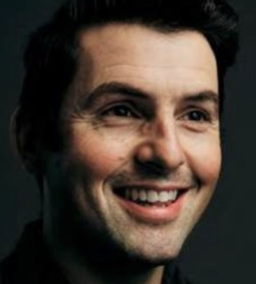
Jim Edmondson co-founded PressWhisper after PR agencies quoted him around £5,000 a month, six months minimum, to pitch AVRE Industries, the heritage clothing brand he started with historian James Holland and comedian Al Murray. He took it personally and built the software instead. PressWhisper clients have since been covered in PRINT magazine and on TheBusinessDesk. He's dyslexic and lives in Cornwall. presswhisper.com